



Optimizing your Google Business Profile is table stakes. Every HVAC company, plumber, and landscaper in Houston has done it. But when someone in The Heights searches "emergency plumber near me" at 9 PM, only three businesses appear in the local pack. The rest are invisible.
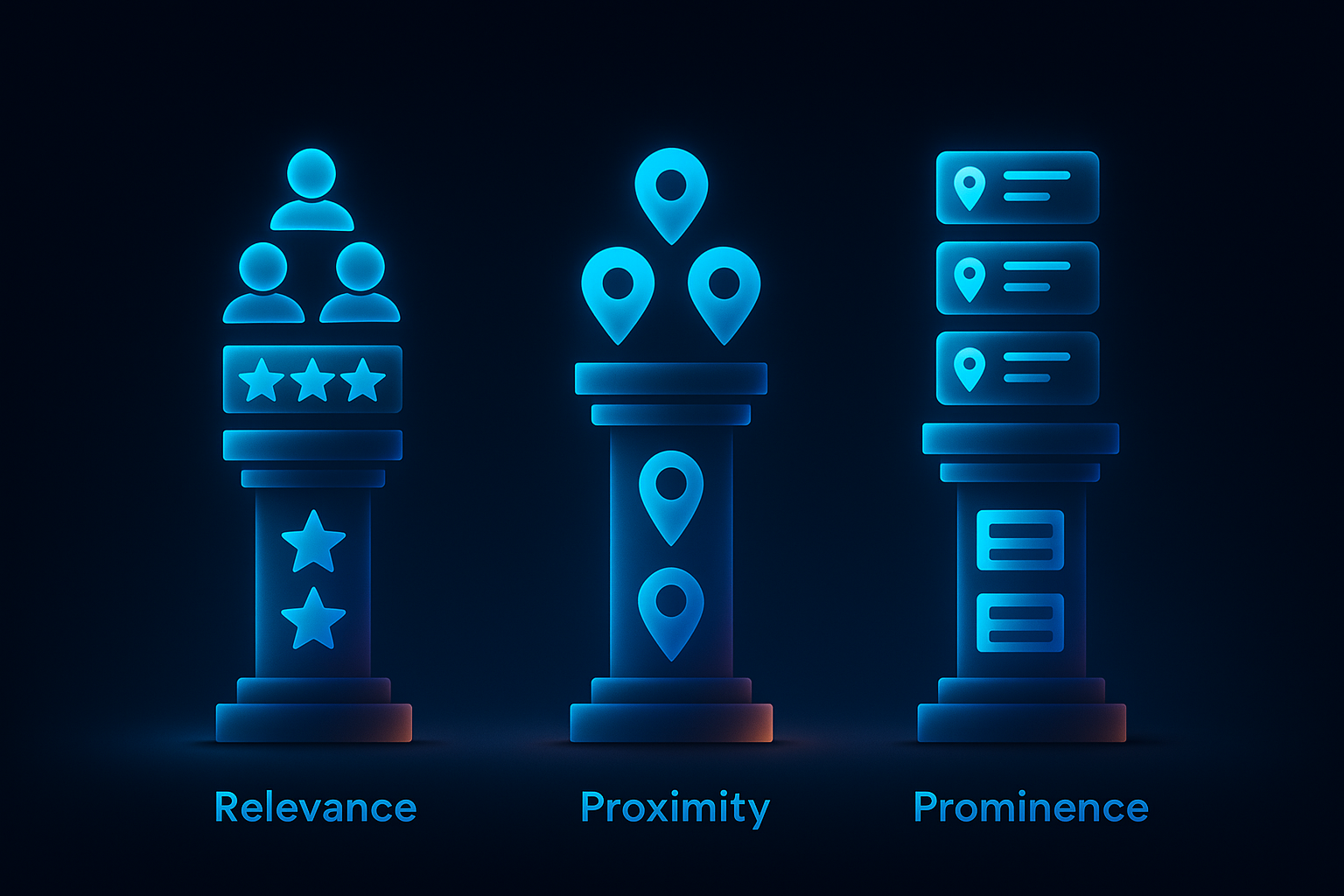
Ranking in Google Maps is not about filling out your GBP fields. It's about proximity, prominence, and relevance—three signals Google measures in real time every time someone searches. This post breaks down the technical factors that separate the businesses in the pack from the ones buried on page two.
The Three Pillars Google Uses to Rank Local Service Businesses
Google's local ranking algorithm evaluates every business against three core dimensions. Understanding how each one works—and which levers you can actually pull—is the foundation of a Maps ranking strategy.
Relevance: Does Your Business Match the Search Intent?
Relevance measures how well your business profile matches what the searcher is looking for. Google reads your primary category, secondary categories, business description, services list, and the words people use in reviews.
If your GBP primary category is "HVAC contractor" but you only talk about air duct cleaning in your description and services, Google won't show you for "AC repair Houston." The algorithm needs consistent signals across every field. Use the most specific primary category that matches your core revenue driver, then add secondary categories for related services.
Service attributes matter too. A plumber who lists "emergency service" and "24-hour availability" will rank for after-hours searches. A landscaper who adds "artificial turf installation" and "irrigation system repair" picks up long-tail queries that competitors miss.
Proximity: How Close Is the Searcher to Your Business?
Proximity is the distance between the searcher's location and your business address. It's the one ranking factor you can't optimize—your physical location is fixed. But you can build a strategy around it.
If you're a service-area business (SAB) with no public storefront, Google uses your registered address as the center point even though it doesn't display on Maps. That's why a Memorial plumber ranks higher for "plumber near me" when the searcher is in Memorial, while a Katy plumber wins the same query from someone in Cinco Ranch.
The strategic move: if you serve multiple metro zones—The Woodlands, Sugar Land, and central Houston—you need location pages on your website for each area, with real content about the work you do there. Internal landing pages signal to Google that you're relevant across a wider service radius, which matters for queries that include neighborhood names.
Prominence: How Well-Known and Trusted Is Your Business?
Prominence combines review count, review velocity (how often you get new ones), average rating, citation consistency (NAP across the web), backlinks to your site, and on-site authority. It's Google's measure of whether you're a real, active business or a placeholder listing.
Two businesses in the same location with identical categories will not rank the same if one has 240 reviews and the other has 11. Review volume is a direct ranking signal. But velocity matters more than raw count—a business that earned 30 reviews in the last 90 days will often outrank one with 200 old reviews and nothing recent.
Ask every customer. Not just the happy ones—every single one. Use a post-service email or text with a direct link to your GBP review page. If you complete 50 jobs a month and convert 15% to reviews, you'll add 90 reviews per year, which puts you in the top decile for most service categories in Houston.
Service Area Strategy: How to Rank Across a 30-Mile Metro Without Multiple Locations
Most Houston service businesses don't operate from a single ZIP code—they serve Katy, The Woodlands, Pearland, and everything in between. But Google's algorithm is built for proximity. Here's how to stretch your radius.
Your GBP service area setting does not improve your ranking outside your immediate area. It tells Google where you're willing to travel, not where you're likely to rank. If your office is in Bellaire and you list Sugar Land in your service areas, you still won't crack the local pack for "electrician Sugar Land" unless you have website content and citations that back it up.
The fix is location-specific landing pages. Not doorway pages—real, useful content about the work you do in each zone. A page titled "HVAC Repair in Katy, TX" should include:
- Unique copy (300+ words) about the neighborhoods you serve, common service calls in that area, and local project examples
- Schema markup with your business name, service type, and the specific area covered
- Embedded Google Map centered on that zone
- Customer testimonials or case studies from jobs in that area
- Internal links to your main service pages
When you build this structure across five or six key areas, Google starts associating your business with those locations in organic search. The GBP pack is still driven by proximity, but when someone clicks through to your site from Maps, the relevance boost from strong location pages can move you up one or two spots over time.

Real Houston Example: How a Memorial HVAC Company Expanded Into Katy
One of our clients operates from a Memorial address. They were ranking #1 or #2 for HVAC queries within a three-mile radius but invisible in Katy, even though 20% of their revenue came from there. The GBP was set to serve Katy, but Google didn't connect the two.
We built a Katy landing page with content about common AC issues in newer construction (relevant to Cinco Ranch and Grand Lakes), added ten Katy-specific reviews to the GBP by asking customers from that area to mention the neighborhood, and secured two local citations from Katy business directories. Within 90 days the client appeared in position 4–6 for "AC repair Katy" from searchers in that zone, and calls from the 77494 area code doubled.
The lesson: proximity is fixed, but relevance and prominence are movable. Google needs multiple signals that you're active in an area before it trusts you enough to show you there.
Technical On-Page Factors That Influence Maps Ranking
Your website's technical health directly affects how Google evaluates your business for local queries. These are the factors that most service companies ignore:
NAP Consistency Across Every Citation
Your business name, address, and phone number must be identical everywhere they appear: GBP, your website footer, Yelp, Angi, BBB, industry directories, and any local chamber or association listing. Inconsistent formatting—"Houston, TX" vs. "Houston, Texas" or "(713) 555-1234" vs. "713-555-1234"—creates ambiguity that dilutes your prominence signal.
Run a citation audit quarterly. Search "your business name" + Houston in Google and check the top 20 results. Fix any mismatches immediately.
Schema Markup for LocalBusiness and Service
Structured data tells Google exactly what you do, where you do it, and how to contact you. At minimum, every service business should have LocalBusiness schema on the homepage with your NAP, business type, service area, and operating hours, plus Service schema on each service page describing what you offer.
If Google can't parse your page to understand you're an HVAC contractor in Houston, it won't confidently rank you for HVAC queries. Schema removes that ambiguity. You can validate your markup with Google's Rich Results Test before you publish.
Mobile Speed and Core Web Vitals
Over 80% of local searches happen on mobile, often while the user is in motion or in an emergency. If your site takes six seconds to load or the click-to-call button jumps around while the page renders, Google knows—and it affects your ranking.
Run PageSpeed Insights on your homepage and top service pages. Fix render-blocking resources, compress images, and eliminate layout shifts. A site that loads in under two seconds has a measurable advantage in the local pack, especially for high-intent queries like "emergency plumber Houston."
"Maps ranking is not a GBP game. It's a whole-site, whole-web game. Every citation, every review, every page on your site either builds Google's confidence or introduces doubt."
Review Velocity: The Ranking Factor Most Service Businesses Ignore
Volume matters, but recency and frequency matter more. A business with 80 reviews and ten in the last 30 days will often outrank one with 200 reviews and two in the last six months. Google interprets consistent review activity as a sign that the business is operational, responsive, and worth showing to searchers.
Set a target: one review per 20 completed jobs is realistic for most service industries. If you do 40 jobs a month, aim for two reviews per week. Build the ask into your workflow—send the request 24 hours after project completion, when satisfaction is high and the experience is fresh.
Respond to every review, positive or negative, within 48 hours. Responses don't directly affect ranking, but they increase the likelihood that future customers will leave a review when they see you're engaged. That creates a compounding effect: more reviews → higher ranking → more visibility → more jobs → more reviews.
What to Do This Week
If you want to move up in Google Maps for your Houston service business, start with these five actions:
- Audit your GBP primary category. Make sure it matches your highest-revenue service. If you're a "general contractor" but 70% of your work is kitchen remodeling, switch to "kitchen remodeler."
- Check NAP consistency. Google your business name and city. Fix any listings with outdated addresses or phone numbers.
- Review your website's location pages. Do you have real, unique content for each area you serve, or just a list of ZIP codes? Build out the weak ones.
- Set up a review request process. Send a message with a direct GBP review link within 24 hours of job completion. Track the conversion rate.
- Add LocalBusiness schema to your homepage. If you don't have it, it takes 20 minutes. Use Google's Structured Data Markup Helper to generate the code.
Local pack ranking is not mysterious. It's a system. Google tells you what it measures—relevance, proximity, prominence—and gives you the tools to influence two of the three. Most service businesses never build the infrastructure. When you do, the gap between you and your competitors widens fast.
Need help with your Houston local SEO strategy? Our SEO services include Google Business Profile optimization, citation management, review systems, and the technical on-page work that makes it all perform. Talk to us if you're ready to show up when your customers search.
.png)
.png)
.png)
.png)
.png)
.png)
.png)
.png)
.png)
.png)
