


If you operate a franchise or multi-location business, you've run into this problem: you need a dedicated page for every location to rank in local search, but writing 50 unique pages about the same service feels impossible. Copy-paste the template across all locations and Google treats it as duplicate content. Write nothing and you don't rank.
The solution isn't more words—it's the right structure. Location pages that rank in "near me" searches and Google Maps share a predictable content pattern that balances efficiency with uniqueness. Here's exactly what to put on each page.
Why Duplicate Location Pages Kill Franchise SEO
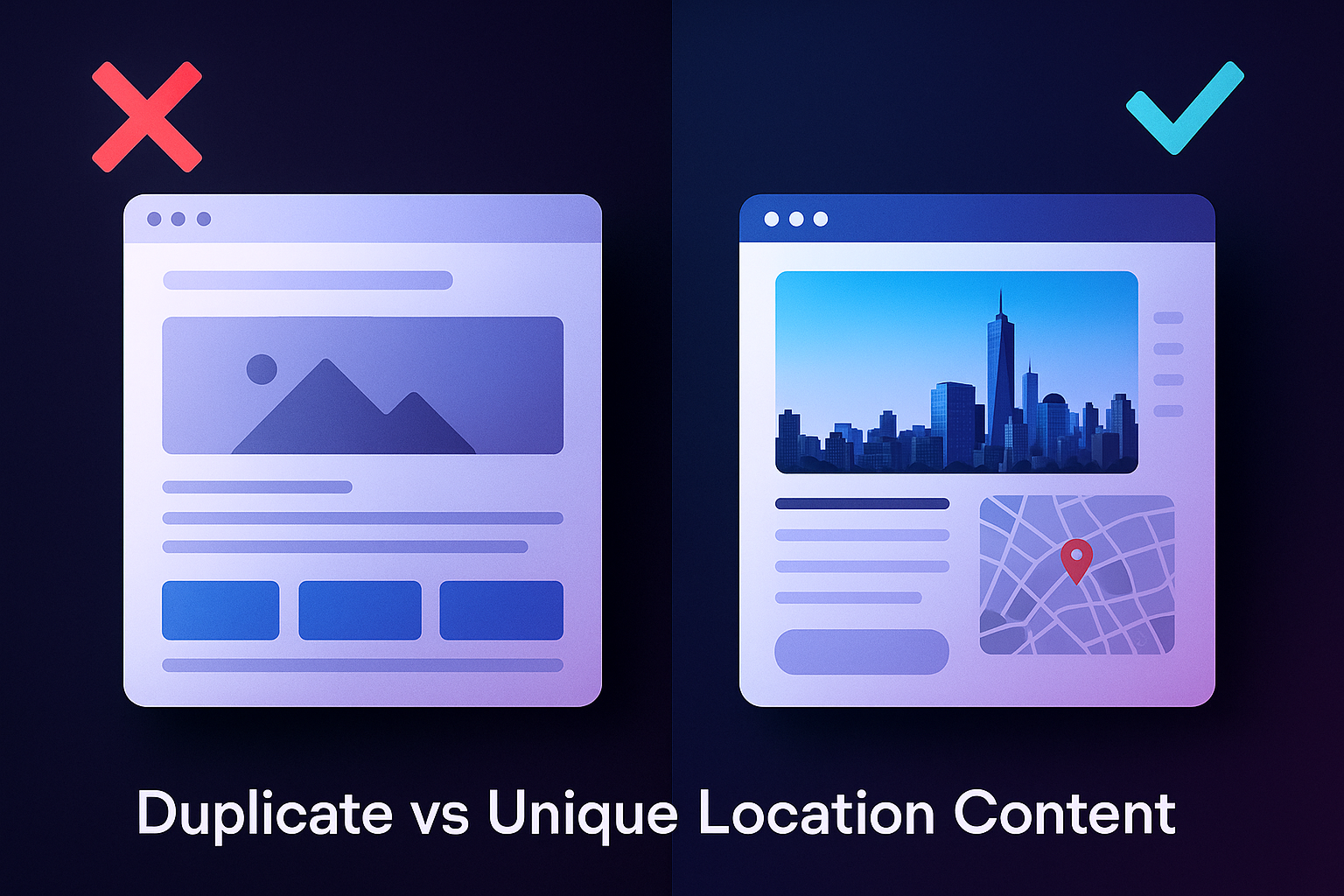
Google's duplicate content filter doesn't penalize your site in the traditional sense—it just picks one version to show and ignores the rest. When 30 of your franchise locations use identical service descriptions and CTAs, Google arbitrarily decides which page deserves the ranking. Usually it's not the one you want.
Worse, thin or duplicate pages dilute crawl budget. If Googlebot visits your site and finds 50 pages that look nearly identical, it will crawl your site less often and index new content more slowly. For franchises launching new locations or updating service offerings, that delay costs real revenue.
The benchmark: each location page needs at least 300–500 words of unique, locally relevant content. That doesn't mean inventing fake differences—it means surfacing real operational details that already exist.
The 6-Block Location Page Template
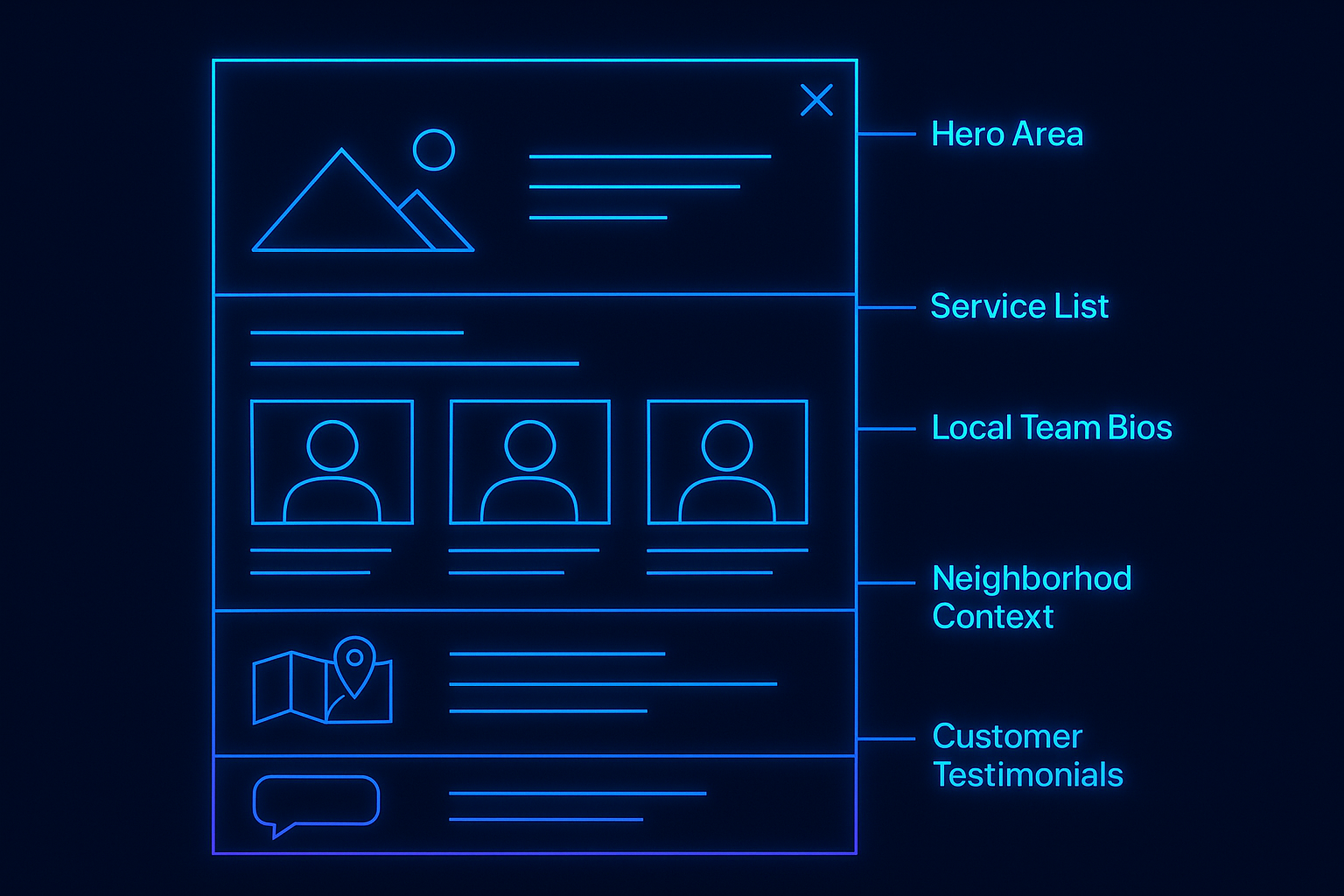
Every high-performing franchise location page we've audited contains these six content blocks. Not all blocks need to be long, but all six should be present and locally specific.
1. Hero Section with Location-Specific Headline
Your H1 should name the service and the neighborhood or city. Not "Premier HVAC Services" on every page—"HVAC Repair & Installation in Montrose, Houston" for the Montrose location and "HVAC Services in Sugar Land, TX" for Sugar Land.
Include the full address, phone number (ideally a local tracking number), and hours. If hours vary by location—especially for franchises in different time zones or with weekend variations—list them explicitly.
2. Service List with Local Context
Yes, every location offers the same core services. The key is adding one sentence of local context per service. A franchise HVAC company in Katy might note: "Our duct cleaning service is especially popular in Katy's newer subdivisions where construction dust is common." The same company in Galveston writes: "Our humidity control systems are built for coastal climates and salt air exposure."
This isn't fabrication—it's operational truth. Your Katy techs do see more new-construction dust calls. Your Galveston team does replace more corroded components. Write what's true.
3. Local Team or Operator Bio
If the location has a general manager, franchise owner, or lead technician, put their name and photo on the page. A three-sentence bio: how long they've been with the company, what they did before, one personal detail (coached little league, grew up two miles away, worked in the industry 15 years).
This block alone adds 100–150 unique words and builds trust. It's also the content block that's easiest to produce: ask the location lead to write it themselves.
4. Neighborhood or Service Area Description
Describe the geography this location serves. Not a legal disclaimer—a real paragraph. "Our Pearland location serves Pearland, Friendswood, and South Houston. We're five minutes from Highway 288 and typically reach most service calls within 30 minutes."
Name the neighborhoods, landmarks, or ZIP codes. If you serve commercial clients, name the business districts. If you're a med spa franchise, mention the nearby shopping centers where your clients come from. Use the vocabulary your customers use when they describe where they live.
"The franchises that rank in local pack results don't write more content—they write content that reflects real operational differences between locations."
5. Customer Reviews or Testimonials (Location-Specific)
Pull two or three Google reviews that mention this specific location and embed them. If you use a reputation management platform, filter by location and display recent testimonials. Even better: write a one-sentence intro like "Here's what our Woodlands clients say" and rotate the testimonials monthly.
If you don't have enough reviews yet, this is a signal to start asking. Optimizing your Google Business Profile includes review velocity—the rate at which new reviews arrive.
6. Frequently Asked Questions (Localized)
Three FAQs minimum, and at least one should be location-specific. Generic: "Do you offer same-day service?" Local: "Do you service homes in Sienna Plantation?" or "Are you licensed in Fort Bend County?"
FAQ schema markup makes these questions eligible for rich results. Write them the way people actually search: question as the heading, direct answer in the first sentence, supporting detail after.
Where to Find the Local Details (Without Inventing Them)
The objection we hear: "But all our locations really do offer the same thing. We don't have unique details." You do—you're just not surfacing them. Here's where to look:
- Service tickets and CRM data: What are the top three service requests at this location? What questions do customers ask most often? That variance is your content.
- Staff interviews: Spend 15 minutes with the location lead. Ask what's different about this market, what surprises new hires, what local competitors do poorly.
- Google Business Profile insights: What search queries bring up your GBP listing? What questions appear in the Q&A section?
- Neighborhood research: Is this location near a university (student housing needs)? A retirement community (accessibility services)? An industrial park (commercial hours)?
- Local events or sponsorships: Does this franchise sponsor a little league team, participate in a chamber of commerce, or run a booth at a farmers market? One sentence about community involvement is unique and true.
The Houston Example: A Med Spa Franchise with 4 Locations
We worked with a Houston-area med spa franchise that had four locations: River Oaks, The Woodlands, Sugar Land, and Katy. All four pages initially used identical content except for the address. None ranked past page three for "[neighborhood] botox" or "[city] laser hair removal."
The fix took one week. Each location manager provided:
- A bio and photo
- The three most-booked treatments at their location (River Oaks: injectables and skin tightening; Katy: laser hair removal and body contouring)
- Two Google reviews mentioning their location by name
- Three local FAQs (Sugar Land: "Do you have evening appointments for clients commuting from downtown?" Katy: "Is there parking?")
We added a neighborhood paragraph describing proximity to major intersections and client demographics. Total unique content per page: ~450 words. Within six weeks all four locations appeared in the local 3-pack for their primary keywords. The River Oaks page now ranks #1 for "River Oaks botox."
No backlink campaign. No technical overhaul. Just content that reflected operational reality.
Technical Checklist for Franchise Location Pages
Content is necessary but not sufficient. Each location page also needs:
- Unique title tag: [Service] in [Neighborhood, City] | [Brand Name]
- Unique meta description: Mention the neighborhood, the service, and one differentiator (hours, team, specialization)
- Schema markup: LocalBusiness schema with name, address, phone, geo-coordinates, and opening hours. If you're a franchise with a parent brand, nest it under Organization schema.
- Embedded Google Map: Shows the exact location and reinforces the address in the markup
- Internal links: Link to your main service pages and to other nearby locations if relevant ("Also serving clients from [adjacent city]")
- Mobile-optimized click-to-call: Every phone number should be a tappable link on mobile
If you're running a franchise system at scale, our franchise SEO guide covers the national-level strategy and how location pages fit into your overall site architecture.
Measuring What Works
Track these metrics per location page:
- Impressions and clicks in Search Console for queries containing the city or neighborhood name
- Local pack appearances (use a rank tracker with geo-grid functionality or manually search from the target ZIP code)
- Google Business Profile actions: website clicks, direction requests, phone calls attributed to the GBP listing
- Conversion rate by landing page: Do location pages convert at the same rate as your main service pages? If not, the content may be thin or the CTA unclear.
Most franchise systems see measurable lift within 4–8 weeks if the content is substantive and the technical setup is correct. If you don't see movement in local rankings after two months, the issue is usually one of two things: not enough unique content (you're still templating too much) or missing citations and GBP optimization.
When to Write Location Pages In-House vs. Outsource
If you operate fewer than 10 locations, write these pages in-house. The local knowledge required makes outsourcing slower and less accurate. Give each location manager a template and a 30-minute deadline. Edit for consistency and publish.
If you operate 25+ locations, consider a hybrid: build the template and the structured data in-house, then hire a content team to interview location managers and draft the unique blocks. We do this for multi-location clients who lack the bandwidth to coordinate across dozens of franchisees.
Never use AI to generate these pages at scale without human review. The local details that make location pages rank—staff names, neighborhood quirks, real service patterns—are not in the training data. AI will invent plausible-sounding lies, and Google will ignore the pages.
What Happens When You Skip This Work
Franchises that launch location pages with duplicate content face three predictable problems:
- Cannibalization: Multiple location pages compete for the same keyword, splitting authority and traffic. Neither ranks well.
- Low Quality Score in local pack: Google uses on-page content as a ranking signal in the local algorithm. Thin pages rank below competitors with robust location content.
- Poor user experience: A customer searching "plumber in Katy" who lands on a page that doesn't mention Katy, show a Katy address prominently, or display Katy-specific content will bounce. High bounce rate signals low relevance to Google.
You don't need a 2,000-word essay on every location page. You need 300–500 words of accurate, locally relevant content that answers the searcher's implicit question: "Is this business actually here, and do they understand my area?"
If you're building or redesigning a franchise site and want the infrastructure right from the start, talk to us. We build multi-location systems on Next.js and headless platforms that make scaling location pages efficient without sacrificing uniqueness.
.png)
.png)
.png)
.png)
.png)
.png)
.png)
.png)
.png)
.png)
